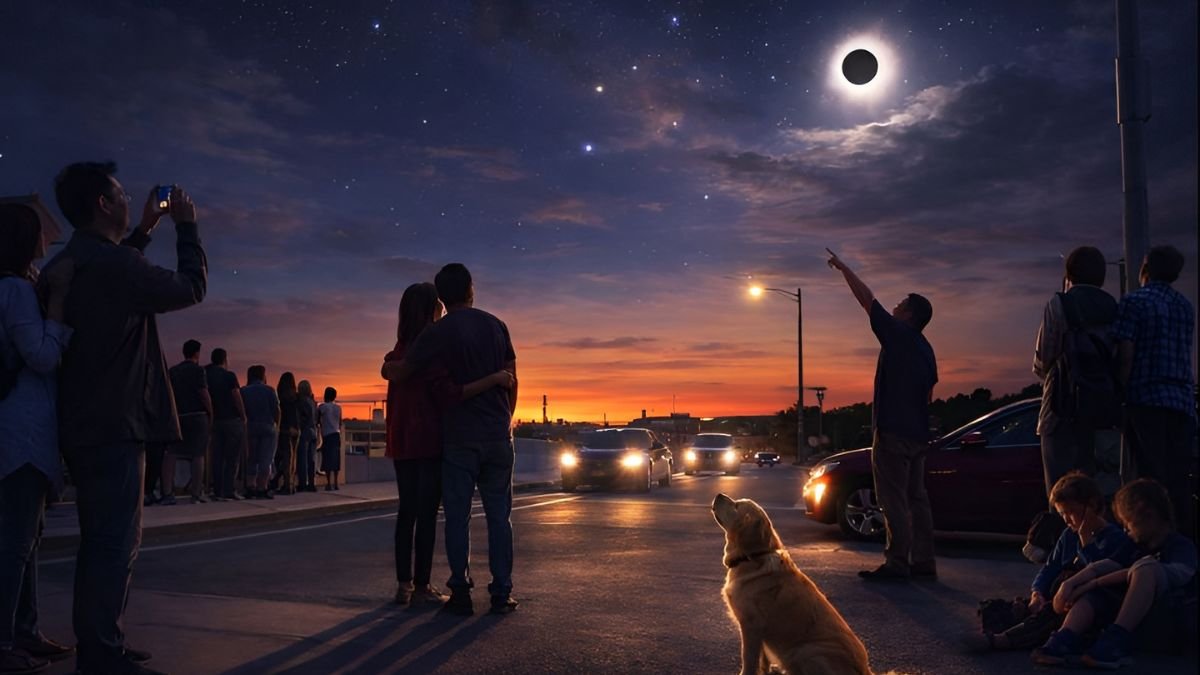
Six minutes of darkness. Long enough to forget what the afternoon looked like. Long enough for your brain to whisper, very quietly: what if this stayed? The longest eclipse of the century is coming, and it will turn day into night in a way most of us have never seen.

Solar eclipses are never just an “astronomy event”. They’re a street performance written by the universe, and this time the show lasts almost six full minutes of total darkness. That’s a lifetime in eclipse terms. Most totalities barely have time to fully land in your body before they’re gone. Here, the Moon will slide so perfectly in front of the Sun that daylight itself feels like it’s being unplugged.
If you want to feel this eclipse in your bones, the first move is simple: place yourself on the path of totality. Not “near it”. Not “80% covered”. The full day-into-night transformation only happens where the Moon completely hides the Sun. That path will be published months in advance by NASA and observatories, down to the kilometer. Pick your spot early. Think logistics: small town or big city, traffic, weather patterns. Then build your day around being outside, with a clear view to the south-southwest sky.
The real magic of a long eclipse isn’t just the sky. It’s the way people and nature misbehave together. As the Sun shrinks to a thin, white crescent, shadows on the ground turn weird. Look under a tree: each gap between leaves becomes a tiny projector, casting hundreds of crescent suns onto the pavement. Temperature drops hit your skin, like walking into a cave. Colors fade. The world takes on that washed-out tint you normally only see in old films or right before a storm. For six minutes, your everyday street gets recast as a movie set.
Once the Sun reclaims the sky and traffic starts moving again, life will slide back into its usual rhythm. Yet an event like this has a way of leaving fingerprints on people’s thoughts. You might catch yourself glancing up more often in the weeks after, noticing the thin curve of a crescent Moon, or the deep blue of a clear morning. A six-minute night at noon reminds you that the roof over your life is alive, moving, quietly choreographed by forces so large they don’t care about your to-do list. That realization can be oddly comforting.