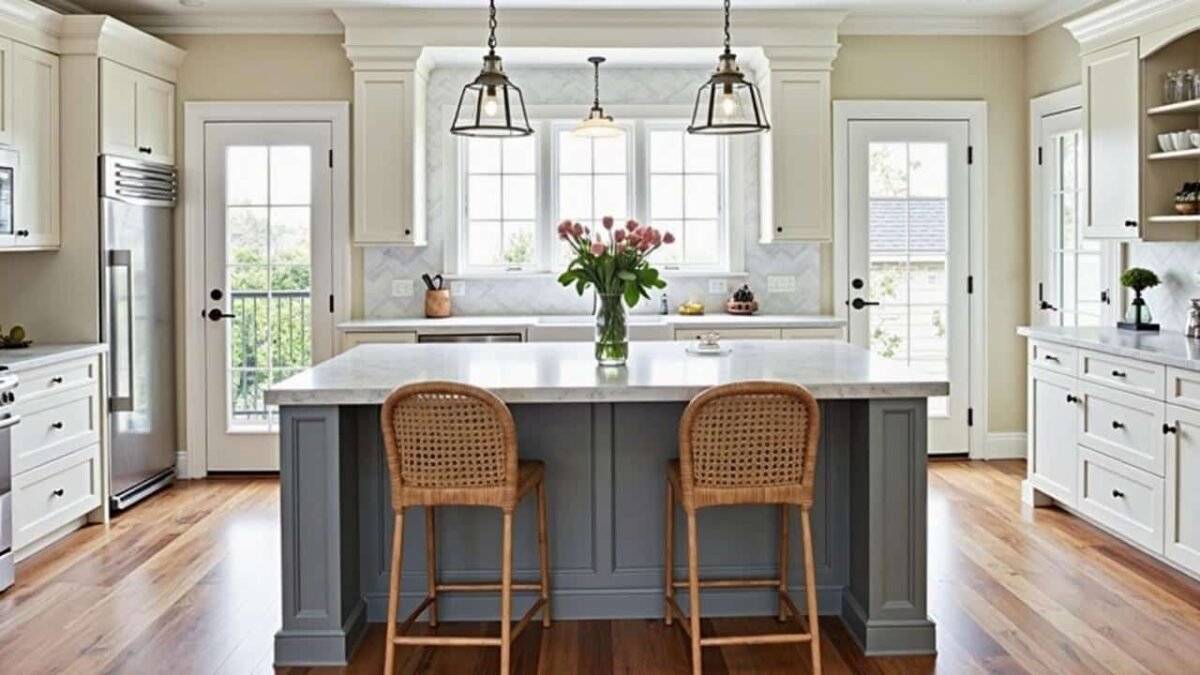
The real turning point isn’t when you pin a dreamy kitchen on Pinterest. It’s when you’re standing in your own kitchen at 7:23 p.m., trying to get dinner on the table, bumping your hip for the third time on that massive island that once felt like the ultimate luxury. The stools are covered in mail, the sides are scuffed from kids’ backpacks, and someone always ends up cooking with their back turned to everyone else. That big block in the middle starts to feel less like “gourmet lifestyle” and more like a traffic jam on four legs.

Across design studios, on Instagram feeds, in new-build showrooms, something is shifting. Architects are quietly drawing fewer islands and more… something else. Something lighter. More fluid. More like a piece of furniture than a fixed monument.
The Era of the Oversized, Built-in Kitchen Island Is Fading
Walk into a high-end kitchen showroom in late 2025 and you might feel it before you see it. The room feels open, less blocked. Your eye travels from window to dining area without snagging on that big rectangular mass in the middle. The sales rep doesn’t lead you to “the island” anymore. They wander instead toward a slender element that looks almost like a modern table, sometimes on legs, sometimes freestanding, often with space underneath.
The era of the oversized, built-in kitchen island is fading. Not with a crash, but like a trend that stayed just a bit too long at the party. Designers talk now about flow, about flexible living, about mixed-use spaces where you can chop vegetables, answer an email, help with homework, and serve drinks, all without standing behind a block of cabinetry. That island, once a symbol of success, suddenly feels like a wall.
The 2026 Replacement: The Practical, Elegant Worktable and Peninsula Combo
The rising star isn’t one rigid product. It’s a family of solutions: slender worktables, airy peninsulas, and hybrid pieces that blur the line between dining table and prep zone. Picture a long, slim table aligned with the kitchen run, at counter height, with drawers tucked underneath and maybe a butcher-block insert at one end. Or a peninsula that extends from a wall of cabinets, with just enough depth for casual breakfasts and quick laptop sessions, while leaving a generous walkway all around.
The trick is to think like a furniture maker, not a cabinet installer. Instead of a chunky box with panels down to the floor, you get legs, light passing underneath, and room for chairs that actually pull in comfortably. Appliances are shifted back to the main run; the central element is freed from the weight of sinks and cooktops. Everyday life gets the center of the room. Not plumbing.
How to Rethink Your Kitchen Before the Island Ages It
The most helpful starting move is brutally simple: tape the island shape on your floor. Masking tape, full scale. Live with it for a few days. Then tape the alternative: a slimmer worktable pushed closer to a wall, or a peninsula coming off a cabinet run. Walk around it while making coffee. Pull out imaginary chairs. Open your fridge door and pretend you’re unloading groceries. The version that feels easier in your body will tell you more than any moodboard.
Once you’ve felt that difference, you can sketch. One sketch with an island block. One with a peninsula. One with a freestanding table, lined up either parallel or perpendicular to your main counter. Keep storage honest: maybe you lose some deep island cabinets, so you add a taller pantry or smarter drawers instead. Remember that your eyes and your feet care about the empty space at least as much as the cabinets.
Are kitchen islands really going “out of style” by 2026?
What exactly is a kitchen worktable?
Is a peninsula better than an island in a small kitchen?
Can I still have seating without an island?
Will skipping an island hurt my home’s resale value?
The real trend underneath this trend isn’t about shapes at all. It’s about kitchens finally admitting they’re living spaces first, task zones second. The kitchens that stand out now aren’t the ones with the biggest block in the middle. They’re the ones that let you move freely, see clearly, and live the way you actually live.