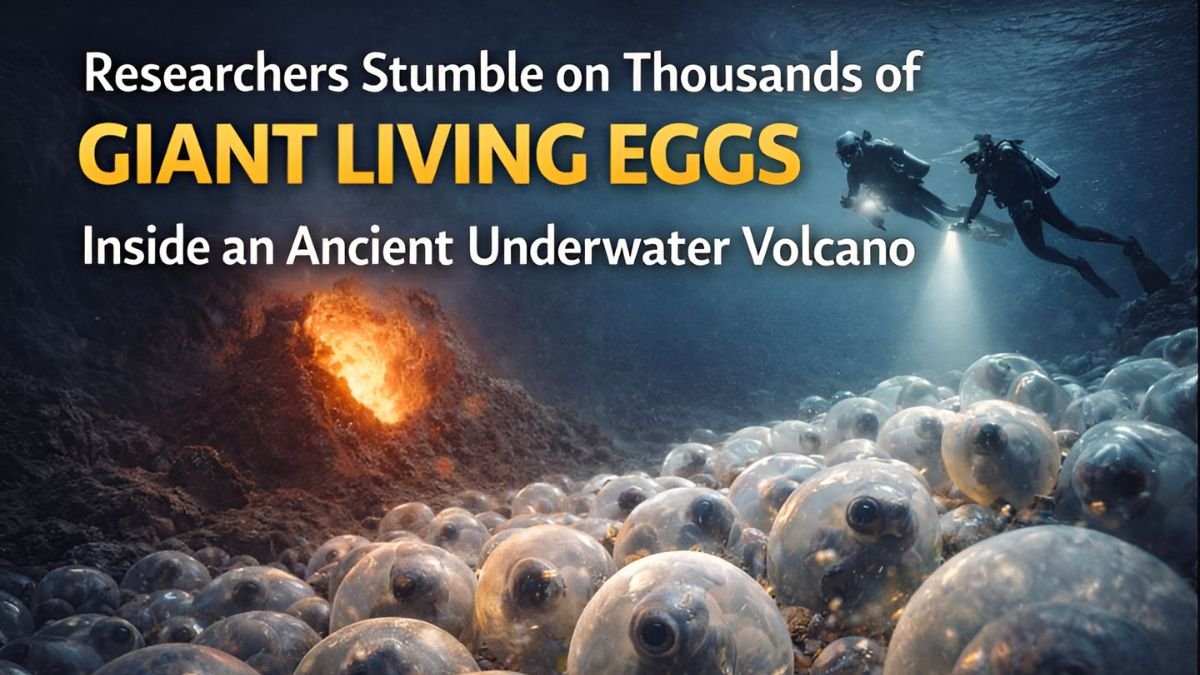
Marine scientists surveying a forgotten volcano near Vancouver Island expected bare rock and cold, dark water. Instead they found a warm summit, thick with life, and carpeted with giant egg cases from a deep‑sea skate that few people have ever seen alive.

An Ancient Volcano That Refused to Die
Since 2019, teams from Fisheries and Oceans Canada have been mapping a submarine volcano covering roughly 2,000 square kilometres off the coast of Vancouver Island. Charts and earlier surveys had labelled it as dormant, but remote-operated vehicles quickly proved that assumption wrong. Cameras showed shimmering plumes rising from fissures on the seafloor, and instruments logged water temperatures higher than the icy deep surrounding it.
The warm outflows feed dense communities of cold-water corals, sponges and other invertebrates that usually struggle in such dark, nutrient-poor depths. Instead of a barren pile of rock, the volcano looked more like a hidden reef, pulsing with subtle movement and color beneath the submersible’s lights.
Thousands of Eggs on a Hidden Summit
The biggest surprise waited near the summit, about 1.5 kilometres below the surface. Here the seafloor changed character: patches of rock disappeared under clusters of pale, leathery capsules. As the cameras zoomed in, researchers realised they were looking at egg cases from Pacific white skate (Bathyraja spinosissima), strewn across the warm high ground.
Counting them precisely is impossible from video alone, yet the sheer density suggests several hundred thousand eggs, and possibly more than a million. No other known nursery ground for deep-sea skates comes close to this scale.
The volcano’s mild warmth appears to shape where the skates lay. Clusters concentrate near vents and subtly heated rock, where temperatures sit just enough above the ambient deep-sea chill to matter for developing embryos.
A Deep-Sea Skate with Giant Eggs
Pacific white skates lurk along the cold North Pacific, from deep canyons off North America to open-ocean ridges. They belong to one of the deepest-living skate species, frequenting waters between about 800 and 2,900 metres. Females can reach around two metres from snout to tail, but their eggs look outsized even for such a large fish. Many measure close to 50 centimetres across.
Rather than the classic rectangular “mermaid’s purse” seen on beaches, these egg cases appear round or gently oval, with soft curves and padded edges. Researchers liken them to small cushions or ravioli scattered over the rock.
Using Volcanic Heat as a Natural Incubator
In the deep ocean, where water often hovers near freezing, skate embryos grow painfully slowly. Biological teams estimate that Pacific white skates need about four years to develop fully inside the capsule under normal deep-sea conditions.
On the warm volcanic summit, the story changes. Even a few extra degrees can accelerate metabolism, shorten development and push juveniles out into the world sooner. Biologist Cherisse Du Preez and colleagues suggest that the warm seamount acts like a natural incubator, with eggs resting in stable pockets between rocks, bathed in slightly elevated temperatures.
How deep do Pacific white skates live?
How large are the skate eggs found on the underwater volcano?
How long do Pacific white skate eggs typically take to develop?
Why is the discovery of this skate egg nursery important for conservation?
Why This Hidden Nursery Matters for Conservation
This kind of discovery has direct consequences for how agencies manage the deep ocean. Pacific white skates reproduce slowly, investing in relatively few, large eggs instead of huge numbers of tiny ones. A four-year incubation, even slightly shortened by warmth, means generations turn over very slowly. That makes the species vulnerable to disturbance.
If a single volcano hosts a large share of the region’s eggs, damage to that nursery could push the population into decline. Bottom trawling, deep-sea mining or unregulated cable routing might crush egg clusters or alter the delicate flow of warm fluids across the summit.
Because of that, researchers now argue that active seamount nurseries deserve special status, similar to marine protected areas around coral reefs or seabird rookeries. Mapping where the heat seeps out, and where the eggs cluster most tightly, will help regulators draw boundaries that actually match the biology on the ground.
How Scientists Map Life on a Dark Volcano
Studying such a remote site requires a mix of technologies. Crews operate research vessels above the volcano, while remote‑operated vehicles descend down the water column on fibre‑optic tethers. High‑definition cameras scan the seafloor, and lasers project scale bars so scientists can estimate egg size and density from video frames.
Temperature sensors and chemical probes hang off the vehicles to track where vent fluids seep out and how far they spread. Back on deck, teams overlay these readings with seafloor maps built from multibeam sonar. The result is a layered view that marries geology, chemistry and biology across the volcano’s flanks and summit.
Volcanoes as Engines of Deep-Sea Biodiversity
This Canadian volcano fits into a broader story about how undersea geology shapes life. Seamounts redirect currents, trap nutrients and offer hard surfaces in a world dominated by mud. Hydrothermal vents and warm seeps add energy and minerals that support both chemosynthetic microbes and more familiar animals such as corals, fish and crustaceans.
For skates, these features provide at least three advantages at once: warmer incubation grounds, elevated terrain with better oxygenated water and structural shelter for egg clusters. Similar benefits may help octopuses, sharks and other deep-sea species that also gather around hydrothermal systems during sensitive life stages.
What This Means for Future Ocean Research
The discovery of giant egg fields on an active volcano sharpens several research questions. How many other seamounts host hidden nurseries that nobody has visited yet? Do different skate species compete for the warmest spots, or partition the volcano by depth and temperature? How will changing ocean chemistry affect the stability of these delicate hotspots?
Researchers now talk about running long-term monitoring on a handful of such sites, with fixed cameras and autonomous vehicles returning each year. Tracking egg numbers, hatch rates and temperature shifts across decades would reveal how these deep-sea reproductive strategies cope with a warming, acidifying ocean.
For non-scientists, the story also offers a way to think about geothermal resources outside the classic image of lava and dramatic eruptions. Most volcanic energy on Earth leaks quietly through places like this: hidden mountains that heat a few degrees of water and, by doing so, tilt the balance of survival for slow-growing, long‑lived animals.
Understanding that subtle connection between heat, time and life can change how we value the dim, distant parts of the seafloor that rarely make headlines, but quietly sustain species that may already be close to their limits.